Showing posts with label Sly. Show all posts

Wednesday, March 14, 2012

You Brought Home Another One? (Part 1)

As anyone who has tried knows, introducing cats can be a difficult thing. The secret is making the introduction as slowly as possible and keeping the interactions between your cats positive. There is no timeline that works for every cat, it depends on their individual personalities and on if your home is set up adequately to house multiple cats. If you've already introduced your cats and it didn't go very well, it's not too late to repair the damage. In this post I'm going to lay out an "ideal" way to introduce cats to each other, as well as give some backtracking tips if your cats are already having problems.

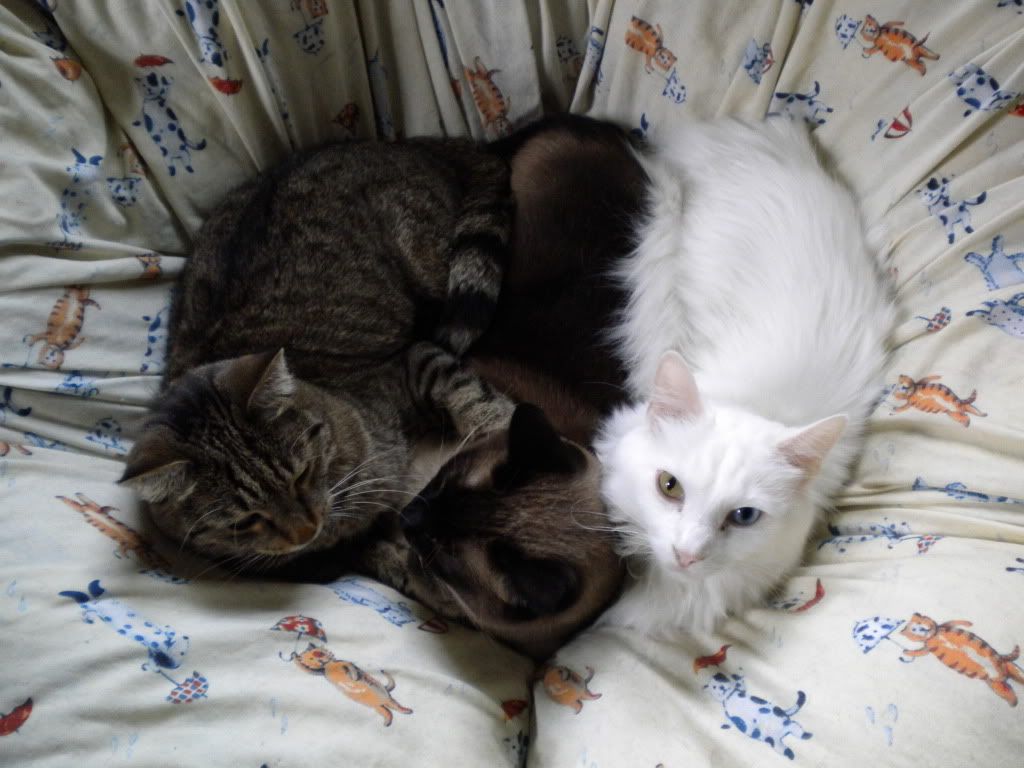
Then someday you'll get to spend your days taking pictures of
adorable cuddle puddles.

PREPARING YOUR HOME
(Best case scenario, you do all this before you get another cat, but these are improvements that can help any cat household no matter how long the cats have been living/fighting together.)

The first thing you need to do is assess your home. If your house isn't multi-cat friendly then you are setting yourself up for failure. To have a smooth introduction and a peaceful life, you first need to check out your litter box situation. The golden rule for litter boxes is: number of cats + 1 and litter boxes should be cleaned daily. Having too few or dirty litter boxes pretty much guarantees cat fights, litter box aversion, or both.

Litter boxes good? Next, your resident cat(s) need a place to mark their territory and your new cat needs some territory to claim as his – for this you need scratching posts and cat trees. (Read about why scratching is important here.) Give your new cat a fresh scratching item, even if it's just one of the lay-on-the-floor cardboard scratchers. Having something of their own to scratch that doesn't smell like the other cats in the home will help you out later on during the actual introduction.

The third thing you should evaluate before bring another cat into your home is vertical space. Like scratching, it's a territory thing. Not having enough vertical space will increase competition in your home and certainly not help your cats get along.

EVALUATE YOUR CURRENT CATS
Are your current cats happy and healthy? Before you bring a new cat home you need to make sure your resident cats are current on their vaccinations and spayed or neutered. Not only do you not want any accidents, but altered cats get along much, much better than they would otherwise. An unaltered male cat would happily kill a new tiny kitten if they were left unattended together in your home.

If you currently have ill or unaltered cats, right now might not be the best time for you to make an addition to your family.
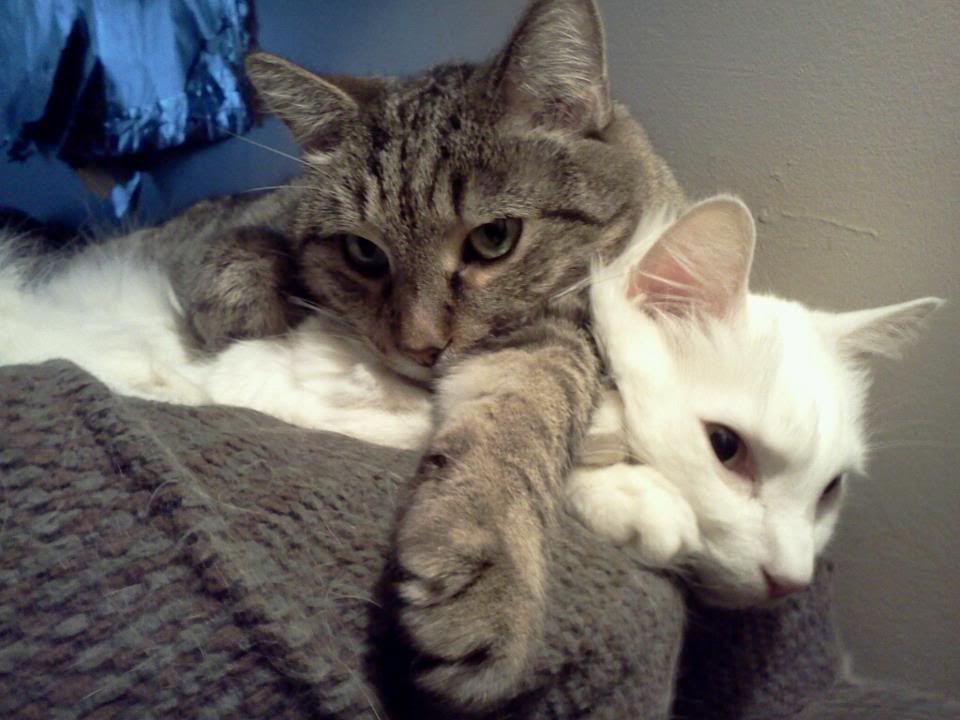

It's hard to believe now that at one time Harry wanted to eat
Damien as a snack.

PREPARING "THE SANCTUARY"
As soon as you walk into your house with a new cat, your current cat(s) are going to know. Even still, your goal is to be as unobtrusive about the new member of your family as possible. Before you bring your new cat home, set up a room just for them.

In this room you need:
  • fresh water
  • food, as needed (dependant on how you're feeding – free or scheduled)
  • a clean litter box
  • something to scratch on
  • something to play with
  • something to sleep on
  • somewhere to hide
When you bring your new cat home, bring them straight to this room. Transport them from wherever you're getting them to this room in a sturdy cat carrier. Try to avoid your other cats, this is a stealth mission. Once in this room, open the carrier door and let your new cat come out. If it's a little kitten, chances are it'll come bounding out and ready to play. A mature cat, however, may take a little time to venture out. Let the cat decide when it is ready to explore it's new home and don't try to force him out!

If you already have a new cat and you're having problems, repeat this step (or do it for the first time). It's the first step to making things better and it keeps your cats safe from each other. Not only are cat fights awful to listen to, but they can cause an array of damage – anything from small bites and scabs, to scratched eyes, to puncture wounds that form abscesses.
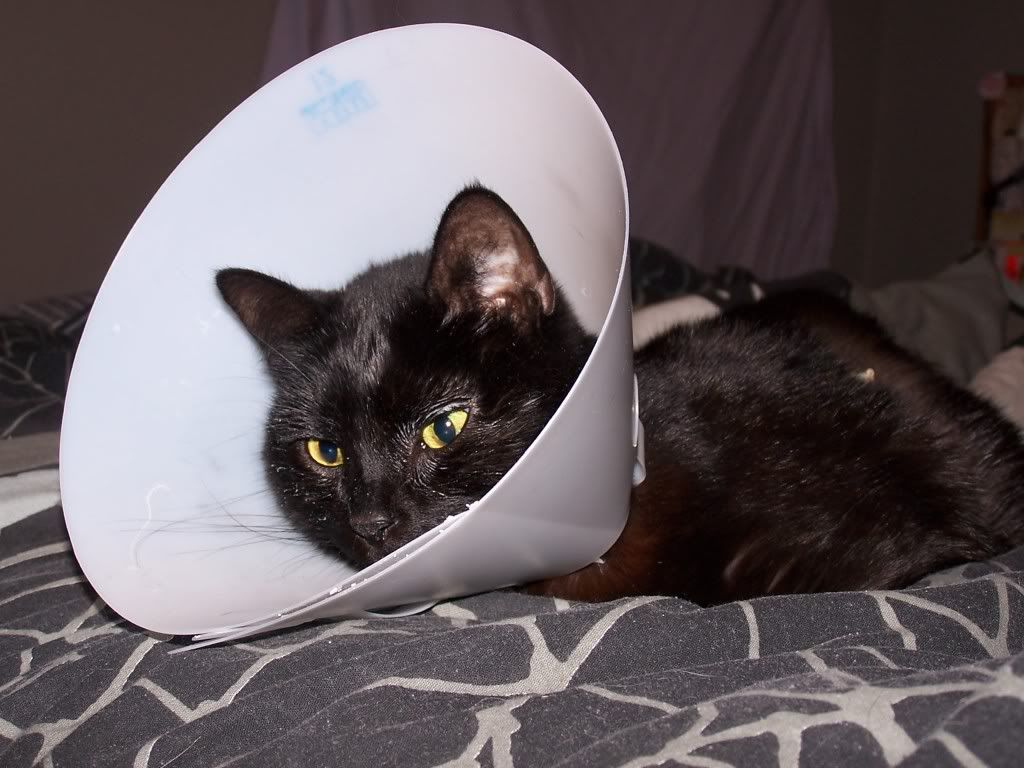
Lola, circa 2004, after getting beat up by another cat while
I was in the shower. She received a puncture wound which
turned into an abscess that had to be drained with a tube.
Nothing about this experience was enjoyable.

NOW WHAT?
You have a new cat! Yay! Keep your new guy in his own private room, and keep your resident cats firmly on the other side of the door. Do not be tempted to do anything more right now. You might think your current cats will be excited for the new addition, and maybe they will be, but rushing the introduction process will only make it take longer to obtain your goal – a peaceful home with cats that like each other.

In Part 2, I will go through the next steps to introducing cats to each other. Until then, just remember that you can't go too slow with this process. Be patient and make sure you show love to all your cats, not just your newbie!



Monday, February 27, 2012

Tiny Scout and Tiny Tuco

Over the weekend I added photos for Tuco, Mona, and Sly, as well as getting some up for Kurtis and Scout. Scout's puppy pictures are just piles of preciousness and Tuco used to be such a little man! Go look for yourself! http://jenyqueenofcats.blogspot.com/p/look-how-cute-my-cats-are.html


Sunday, February 5, 2012

How to Clip Your Cats Nails


This can be really easy, or really hard, depending on your cat. It is something that is pretty easy to get even an older cat used to when done regularly and correctly. 

HELPFUL TIPS
  • Play with your cats feet, push in the pads on their paws, get them to hold hands with you. Make having their paws touched an enjoyable activity. 
  • Start clipping nails at a young age.
  • If you have a cat that already objects to having it's nails clipped, wrap the cat in a towel and get another person to help you. Have one person hold the cat and the other person clip the nails or
  • If your cat doesn't mind having it's paws touched, but doesn't like being restrained, clip their nails while they're lounging somewhere. Tuco objects to having his nails clipped if I try to hold him, but has no problem if I clip them while he's stretched out on the back of the couch.
  • Use grain free treats as bribery to create a positive association for your cat.
  • Give your cat a break during clipping if needed. 

My cat nail clippers.

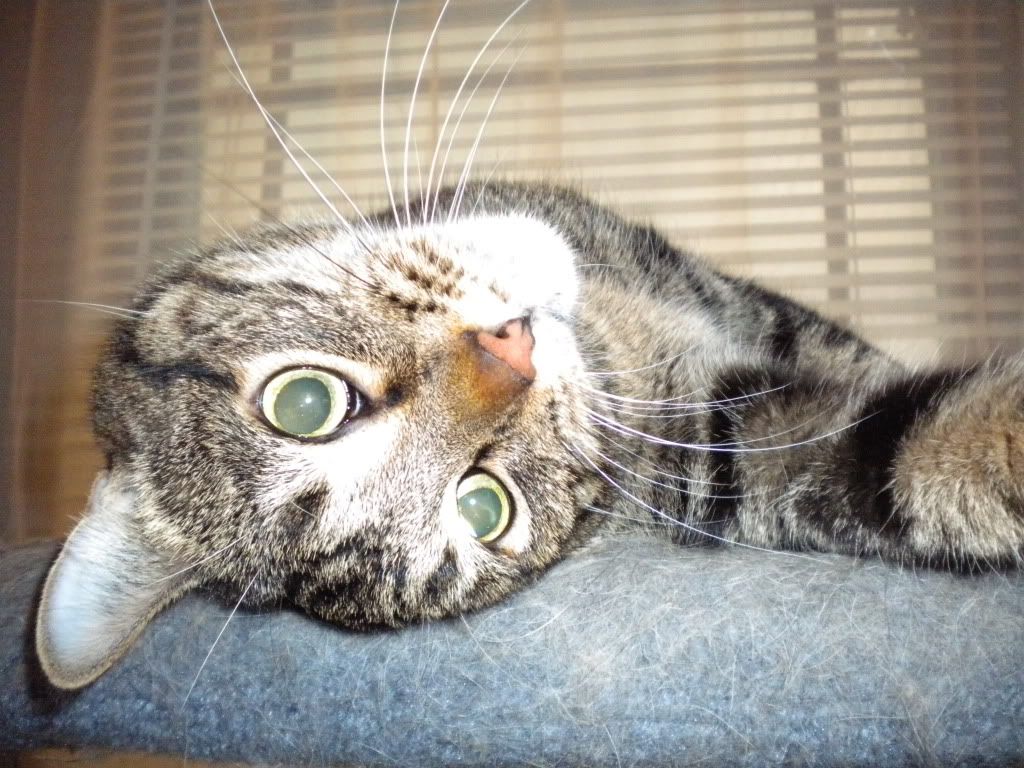
Sly, our volunteer.

 NECESSARY SUPPLIES
 
cat

cat nail clippers

a towel (if necessary)

a helpful friend (if necessary)


You'll want to restrain your cat in some way, but how depends on the individual cat. Your goals are to keep your cat as still and comfortable as possible and to get through the experience without any bites or scratches. The less traumatic it is for your cat, the better, it'll make it easier for you both the next time. Pick a small room where you can close the door, making it easier to give the cat treat eating breaks if needed.

Sly's paw pads.
Holding their paw, lightly press on the paw pad to extend the nail.

Press the paw pad to extend the claw.

In each nail there is a group of blood vessels and nerve endings called the quick. In light colored nails it is the visible red or pink part of the nail. The quick is present in dark colored nails as well, even though you can't see it. Clipping the quick will cause bleeding and pain. If you do nick it, scratch the nail on a dry bar of soap, or dab on some styptic powder or cornstarch to stop the bleeding. Pay attention and make sure the bleeding stops completely.

Cut nail with clippers, avoiding the quick.

Using your clippers, trim the nails one by one. Most of the time I only clip the front claws, but I check the back claws for any exceptionally sharp daggers or broken nails.

Friday, January 20, 2012

How Grain Free Food Changed Our Lives

The best thing that ever happened to my cat family was when my lovely, little Lola started losing all her fur. I know that sounds bizarre, but bear with me, I'll explain.

We had just moved to Chicago, I hadn't found a vet I really liked (still haven't found one I adore for that matter, any recommendations?) and on top of that we were broke. Husband was still looking for a job and I was imagining a vet with dollar signs in their eyes, wanting to do expensive blood work and tests. Since it wasn't an emergency sort of situation, I curled up on my couch and started doing some internet research.

So many diseases can make your cat's hair fall out! So many nasty parasites! Nothing sounded right though, outside of losing her hair, Lola didn't have the symptoms of Eosinophilic Granuloma or Feline Endocrine Alopecia or any other obscure cat disease I read about. One thing was for sure though, she was itching like crazy and balding rapidly.

When I found the answer it wasn't by reading anything about cats. Instead I learned that in dogs, food allergies can cause hair loss. Well, guess what y'all, the same is true for cats.

We learn as little kids that cats are carnivores. Why is it then that pet foods are routinely made using grains as a primary ingredient? Corn, corn gluten meal, oats, barley, brewers rice, not to mention a dozen other unnecessary things, some of which are truly awful. Felines do not require grain in their diets. Grains are nothing but filler, just something to keep the price low for the pet food companies. They cause allergy problems and obesity, leading to even more health problems. 

The number one ingredient in Lola's daily fare? Corn. This is how I became obsessed with pet food.

Within the same week of my revelation, I met a girl named Anna at a neighbor's grill out. Anna works at Soggy Paws*, a local pet store that sells grain free pet foods amongst other things. She was more than happy to have a passionate discussion with me about what I had recently learned and was super excited to come over and meet my cat family. The next day I went to Soggy Paws, where they hooked me up with samples and talked my ear off. 

So there I was, armed with new knowledge and a bag full of cat food, excited to see if all these supposed benefits were going to pan out. Being the giant nerd that I am, I set up a spreadsheet. In it, I listed each cat, any current or reoccurring issues said cat had, their current weight, and what food they were being fed. (When switching a cats food, most people say to do so gradually, over the course of a few weeks. I've heard different opinions, and don't really think it matters a whole lot, but I followed the gradual rule when I switched them on this. Expect some softer poop, or even diarrhea, any way you do it.) Then I followed up weekly, then biweekly, for nine weeks, reweighing and observing.

HAIRBALLS
I opened up that spreadsheet for the first time in a long time to write this post. The first thing that jumped out at me from the "issues" category was our excessive hairball problems. Daily hairballs, sometimes multiple ones a day! Sly was by far the worst. He had a terrible hack, like a little kitty smoker's cough, that produced a hairball about every third time. The vet had given me a hairball paste and told me if there wasn't improvement we might have to x-ray for blockages. The hairball paste wasn't making an impact at all. By week two of switching to grain free, Sly wasn't hacking anymore and overall hairballs for the household were down to a once or twice a week thing. It was amazing. 

WEIGHT ISSUES 
A few of my cats were fatties. Sly comes to mind, he likes to fetch, but had gotten so heavy that he'd be breathing hard by the second toss. During the switch, most of my cats gained a bit of weight at first. This was due to the simple fact that I was feeding them too much. Once I got their portions under control (and an appropriate portion for a cat is much smaller than what most people think), the lack of pointless grain fillers in their food helped my chunky cats to lose weight (with the exception of Boo, my rotund little pumpkin cat, in which there was no change.) In my slender cats, weight change was minimal. WARNING! If your cat qualifies as obese, then you need to be extremely careful while helping your cat lose weight. Losing weight too quickly can further strain their internal organs causing horrible things to happen or even killing them. Please don't try to help your obese cat lose weight without help. In the future, I'm going to write more about this. You can email me if you want to talk about you fat cat sooner (jenyqueenofcats@gmail.com). I know I should recommend that you talk to your vet, so go talk to your vet, but they are probably going to suggest a low calorie cat food laden with grains, and obviously, I'm against that.


Here's one of those charts to help you assess your cat's weight.
Chart via http://www.drsfostersmith.com/
 
COATS/SHEDDING
An unexpected benefit was that every one's fur got sooooooo much softer. Within the first week I noticed it in Harry's fur. After two weeks half my cat population was noticeably softer. The softness came with a small price - shedding. I've never seen so much shedding! Then, as they continued to get softer and softer, the shedding slowed, and now they shed less than ever. After about two months eating grain free food, Lola's fur was looking particularly nice. It was growing back in, softer than ever, and she was no longer licking and chewing constantly.

Grain free foods my cats really like include (canned/wet) Wellness, Dave's, and BFF (although BFF is primarily fish based, so don't use it as your cats main protein source) and (dry) Taste of the Wild. Honestly, the only reason I feed dry food at all is because it's economical. Wet food is really the way to go. It adds to all the benefits of feeding grain free and even better, it's a great way for your cat to get enough water. Raw feeding is another option, but that's for another day. I feed my cats dry food in the morning and wet food in the evening.

Overall, after switching to grain free, the cats have had fewer hairballs, the overweight problem came more under control, they got softer and prettier, started shedding less, have smaller and less frequent poops, and we haven't had any UTI's (Lola and Harry have both had serious problems with that when on dry and grain filled diets). One of my very favorite things about switching to grain free is that when I bring Lola her evening meal she trills an adorable little song while gobbling it down. It's so precious.  


Look at the label on your bag of cat food. Unless you are already intentionally buying grain free food, chances are it's full of a bunch of crap that your cat doesn't need. Websites for grain free foods usually have some sort of "where to buy" button. Click on it, go get some, your cat will be so happy.


*Soggy Paws did not compensate me in any way for the name drop or praise. Let me tell you though, they are an A+ store, and after working in retail for ten years, I have some pretty high standards for retail establishments. If you live in Chicago (or in Omaha, NE, they just opened a store there!), check them out. (Maybe even tell them you read about them here!) http://www.soggypaws.com/