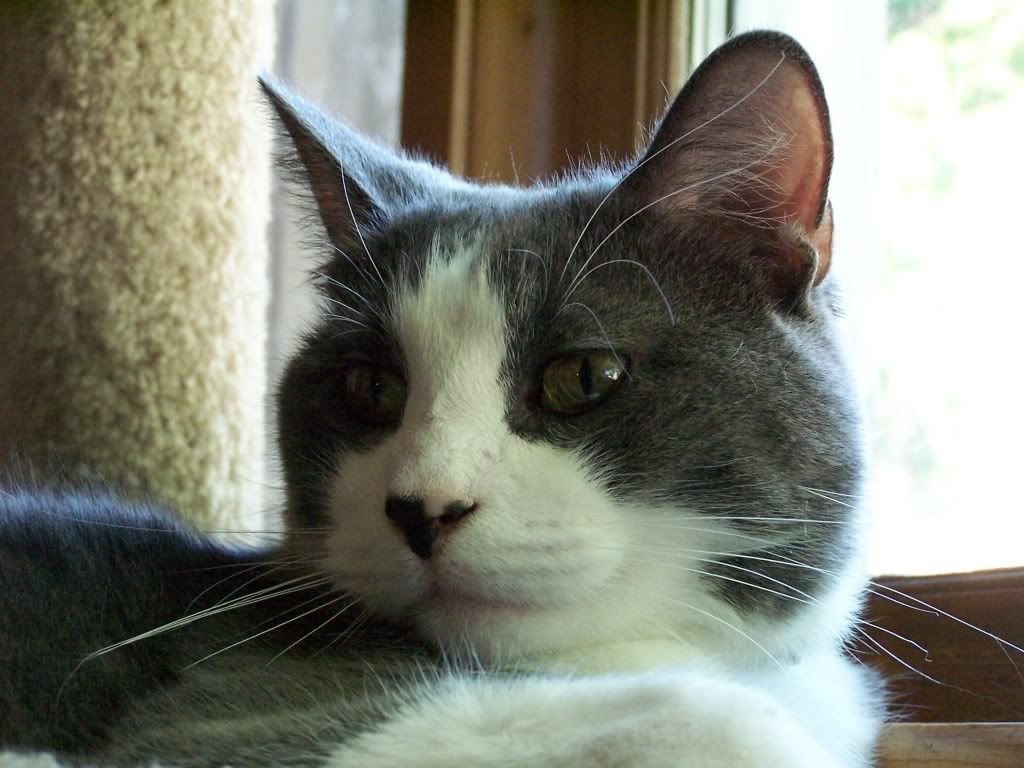
Ever since a bike with a rack became available to me, I've been looking forward to strapping a cat down (in a carrier, mind you) and using the bike to transport a cat to the vet.
On July 19th, I got my chance and Harry got to take his first bike ride.
Granted, I was hoping my first bike ride vet visit would be one of those "check up" vet visits to update shots. Instead, I was bestowed with one of those "injury" visits.
Between Harry's shoulder blades he had a cyst that first showed up about seven years ago. My Omaha vet told me to watch it, and not to worry unless there was a change in size or appearance. Even though her advice to me was not to touch it everyday (she felt it was easier to notice a difference in size if you only checked it a couple of times a month), I fiddled with it all the time.
There were a couple of times that he scratched at it and made it bleed, but other than that, it hadn't changed at all in those seven or so years. Then, in early July, it started growing. I had a cyst of my own once, on my wrist, so I wasn't horribly alarmed. I added "get Harry's cyst cut out" to my to-do list, but it was pretty far down on the list. A "B" priority, if you will.
The evening before Harry's first bike ride, I was feeding everyone, just like normal. While I was gathering the feeding supplies, Harry jumped up on the counter to help me and provide encouragement (aka: to get in my way and meow pathetically at me). I reached out to pet him without averting my eyes from the task at hand and my fingers automatically went to fondle his cyst.
Where the little bump should have been, my fingers found a wet and open wound.
I went running for Georgia, my most amazing vet tech neighbor, who came up and checked it out. Her sound advice to me was that, since it wasn't an emergency, I shouldn't take him to the emergency vet, I should just clean it up and wait until the morning and take him to my normal vet.
The next morning, I put him in his carrier, used bungee cords and dead bike tire tubes to strap it down to the bike rack, and we rode to the vet (which is a very short ride, only two miles). It was great! Harry meowed, but no more than he would have in a car, and, much like when I'm out buying loads of cat food, I felt like a real cat lady, riding down the street with my cat on the back.
Taking care of the remains of the ruptured cyst required Harry to go under the knife, so he had to stay at the vet. He ended up with a handful of stitches and a tube to drain the wound. After three days, we went back and got the tube taken out, and after two weeks they removed his stitches. Surprisingly, he left it alone, outside of presenting it to the dogs, other cats, and people, like he was saying "Hey, look, I have an owie."
Three vet visits, approximately three weeks, and a handful of bike rides later and he's all healed up. I feel like we came out on top in the whole ordeal - the stupid cyst is gone, they cleaned his teeth for cheap since he was already knocked out, and I now know for sure that I can take the cats on a bike ride, although probably not all of them at once!
Showing posts with label health issues. Show all posts
Thursday, August 16, 2012
Friday, February 24, 2012
Adventures in Mouth Ulcers
At age 11, Mr. Pablo Bob is my eldest and least healthy cat. In addition to hyperthyroidism (which is pretty easily controlled with medication), Bob gets these awful, painful mouth ulcers. Now, there are lots of causes for mouth ulcers – vitamin deficiencies, kidney problems, dental issues, and allergies are all common culprits – but unfortunately for Bob and I, he joins the ranks of cats who have this problem without a clear cause.
About three weeks ago these ulcers flared up again, extra bad this time. The last time they got this bad was back in 2009. My vet in Omaha described it as feeling like "your tongue, gums, and throat are covered in canker sores". In other words, unbelievably painful.
Without knowing what is causing these ulcers (his blood work came back normal yet again and he recently had a dental, the vet said his teeth themselves still look great), we can't do anything but treat the symptoms. It's the most helpless feeling, just watching him suffer and drool and be in obvious pain, but to be unable to do anything about it.
When your mouth hurts and you use your mouth to clean yourself, that pretty much just means you are going to be dirty. When Bob's mouth is bothering him he gets so beat up looking. His fur is less shiny and starts to mat, he gets dandruff, and his paws and mouth have dirty stains from attempts at eating. Add to that the terrible asymmetrical hair cut I gave him this time around trying to help out with his mats and you end up with a pretty woebegone kitty.
Back to three weeks ago, Bob started leaving food in his dish at the end of feeding time. Sometimes there are little ulcer flair ups that calm down without interference, so I wasn't too worried. A couple days later, he was only eating once per day, so we started a round of antibiotics (Clindamycin). After about a week of only once a day eating, he stopped eating altogether.
After his 4th uneaten meal I called into work for the following morning and took him to the vet as soon as they opened. Dr. Basran gave him a stronger antibiotic in the form of a shot and another shot of painkiller. As soon as those painkillers were coursing through his system he scarfed down an entire can of food and I stopped panicking.
It's been a week since our vet visit and Bob's eating is still spotty. The vet asked me to call him today so we could talk about how he was doing, but then wasn't in the office. Guess I'll be calling him up again tomorrow. Has anyone else had to deal with mouth ulcers in themselves or their pets?
| Bob in his handsomer days. |
Without knowing what is causing these ulcers (his blood work came back normal yet again and he recently had a dental, the vet said his teeth themselves still look great), we can't do anything but treat the symptoms. It's the most helpless feeling, just watching him suffer and drool and be in obvious pain, but to be unable to do anything about it.
When your mouth hurts and you use your mouth to clean yourself, that pretty much just means you are going to be dirty. When Bob's mouth is bothering him he gets so beat up looking. His fur is less shiny and starts to mat, he gets dandruff, and his paws and mouth have dirty stains from attempts at eating. Add to that the terrible asymmetrical hair cut I gave him this time around trying to help out with his mats and you end up with a pretty woebegone kitty.
Back to three weeks ago, Bob started leaving food in his dish at the end of feeding time. Sometimes there are little ulcer flair ups that calm down without interference, so I wasn't too worried. A couple days later, he was only eating once per day, so we started a round of antibiotics (Clindamycin). After about a week of only once a day eating, he stopped eating altogether.
After his 4th uneaten meal I called into work for the following morning and took him to the vet as soon as they opened. Dr. Basran gave him a stronger antibiotic in the form of a shot and another shot of painkiller. As soon as those painkillers were coursing through his system he scarfed down an entire can of food and I stopped panicking.
It's been a week since our vet visit and Bob's eating is still spotty. The vet asked me to call him today so we could talk about how he was doing, but then wasn't in the office. Guess I'll be calling him up again tomorrow. Has anyone else had to deal with mouth ulcers in themselves or their pets?
Friday, January 20, 2012
How Grain Free Food Changed Our Lives
The best thing that ever happened to my cat family was when my lovely, little Lola started losing all her fur. I know that sounds bizarre, but bear with me, I'll explain.
HAIRBALLS
WEIGHT ISSUES
A few of my cats were fatties. Sly comes to mind, he likes to fetch, but had gotten so heavy that he'd be breathing hard by the second toss. During the switch, most of my cats gained a bit of weight at first. This was due to the simple fact that I was feeding them too much. Once I got their portions under control (and an appropriate portion for a cat is much smaller than what most people think), the lack of pointless grain fillers in their food helped my chunky cats to lose weight (with the exception of Boo, my rotund little pumpkin cat, in which there was no change.) In my slender cats, weight change was minimal. WARNING! If your cat qualifies as obese, then you need to be extremely careful while helping your cat lose weight. Losing weight too quickly can further strain their internal organs causing horrible things to happen or even killing them. Please don't try to help your obese cat lose weight without help. In the future, I'm going to write more about this. You can email me if you want to talk about you fat cat sooner (jenyqueenofcats@gmail.com). I know I should recommend that you talk to your vet, so go talk to your vet, but they are probably going to suggest a low calorie cat food laden with grains, and obviously, I'm against that.
COATS/SHEDDING
We had just moved to Chicago, I hadn't found a vet I really liked (still haven't found one I adore for that matter, any recommendations?) and on top of that we were broke. Husband was still looking for a job and I was imagining a vet with dollar signs in their eyes, wanting to do expensive blood work and tests. Since it wasn't an emergency sort of situation, I curled up on my couch and started doing some internet research.
So many diseases can make your cat's hair fall out! So many nasty parasites! Nothing sounded right though, outside of losing her hair, Lola didn't have the symptoms of Eosinophilic Granuloma or Feline Endocrine Alopecia or any other obscure cat disease I read about. One thing was for sure though, she was itching like crazy and balding rapidly.
When I found the answer it wasn't by reading anything about cats. Instead I learned that in dogs, food allergies can cause hair loss. Well, guess what y'all, the same is true for cats.
We learn as little kids that cats are carnivores. Why is it then that pet foods are routinely made using grains as a primary ingredient? Corn, corn gluten meal, oats, barley, brewers rice, not to mention a dozen other unnecessary things, some of which are truly awful. Felines do not require grain in their diets. Grains are nothing but filler, just something to keep the price low for the pet food companies. They cause allergy problems and obesity, leading to even more health problems.
The number one ingredient in Lola's daily fare? Corn. This is how I became obsessed with pet food.
Within the same week of my revelation, I met a girl named Anna at a neighbor's grill out. Anna works at Soggy Paws*, a local pet store that sells grain free pet foods amongst other things. She was more than happy to have a passionate discussion with me about what I had recently learned and was super excited to come over and meet my cat family. The next day I went to Soggy Paws, where they hooked me up with samples and talked my ear off.
So there I was, armed with new knowledge and a bag full of cat food, excited to see if all these supposed benefits were going to pan out. Being the giant nerd that I am, I set up a spreadsheet. In it, I listed each cat, any current or reoccurring issues said cat had, their current weight, and what food they were being fed. (When switching a cats food, most people say to do so gradually, over the course of a few weeks. I've heard different opinions, and don't really think it matters a whole lot, but I followed the gradual rule when I switched them on this. Expect some softer poop, or even diarrhea, any way you do it.) Then I followed up weekly, then biweekly, for nine weeks, reweighing and observing.
HAIRBALLS
I opened up that spreadsheet for the first time in a long time to write this post. The first thing that jumped out at me from the "issues" category was our excessive hairball problems. Daily hairballs, sometimes multiple ones a day! Sly was by far the worst. He had a terrible hack, like a little kitty smoker's cough, that produced a hairball about every third time. The vet had given me a hairball paste and told me if there wasn't improvement we might have to x-ray for blockages. The hairball paste wasn't making an impact at all. By week two of switching to grain free, Sly wasn't hacking anymore and overall hairballs for the household were down to a once or twice a week thing. It was amazing.
WEIGHT ISSUES
| Here's one of those charts to help you assess your cat's weight. Chart via http://www.drsfostersmith.com/ |
COATS/SHEDDING
An unexpected benefit was that every one's fur got sooooooo much softer. Within the first week I noticed it in Harry's fur. After two weeks half my cat population was noticeably softer. The softness came with a small price - shedding. I've never seen so much shedding! Then, as they continued to get softer and softer, the shedding slowed, and now they shed less than ever. After about two months eating grain free food, Lola's fur was looking particularly nice. It was growing back in, softer than ever, and she was no longer licking and chewing constantly.
Grain free foods my cats really like include (canned/wet) Wellness, Dave's, and BFF (although BFF is primarily fish based, so don't use it as your cats main protein source) and (dry) Taste of the Wild. Honestly, the only reason I feed dry food at all is because it's economical. Wet food is really the way to go. It adds to all the benefits of feeding grain free and even better, it's a great way for your cat to get enough water. Raw feeding is another option, but that's for another day. I feed my cats dry food in the morning and wet food in the evening.
Overall, after switching to grain free, the cats have had fewer hairballs, the overweight problem came more under control, they got softer and prettier, started shedding less, have smaller and less frequent poops, and we haven't had any UTI's (Lola and Harry have both had serious problems with that when on dry and grain filled diets). One of my very favorite things about switching to grain free is that when I bring Lola her evening meal she trills an adorable little song while gobbling it down. It's so precious.
Look at the label on your bag of cat food. Unless you are already intentionally buying grain free food, chances are it's full of a bunch of crap that your cat doesn't need. Websites for grain free foods usually have some sort of "where to buy" button. Click on it, go get some, your cat will be so happy.
*Soggy Paws did not compensate me in any way for the name drop or praise. Let me tell you though, they are an A+ store, and after working in retail for ten years, I have some pretty high standards for retail establishments. If you live in Chicago (or in Omaha, NE, they just opened a store there!), check them out. (Maybe even tell them you read about them here!) http://www.soggypaws.com/
Labels:
basic care,
feeding,
grain free,
hairballs,
Harry James,
health issues,
Lola,
pets,
shedding and coat care,
Sly,
weight issues
Subscribe to:
Posts (Atom)