Showing posts with label litter box. Show all posts

Wednesday, March 14, 2012

You Brought Home Another One? (Part 1)

As anyone who has tried knows, introducing cats can be a difficult thing. The secret is making the introduction as slowly as possible and keeping the interactions between your cats positive. There is no timeline that works for every cat, it depends on their individual personalities and on if your home is set up adequately to house multiple cats. If you've already introduced your cats and it didn't go very well, it's not too late to repair the damage. In this post I'm going to lay out an "ideal" way to introduce cats to each other, as well as give some backtracking tips if your cats are already having problems.

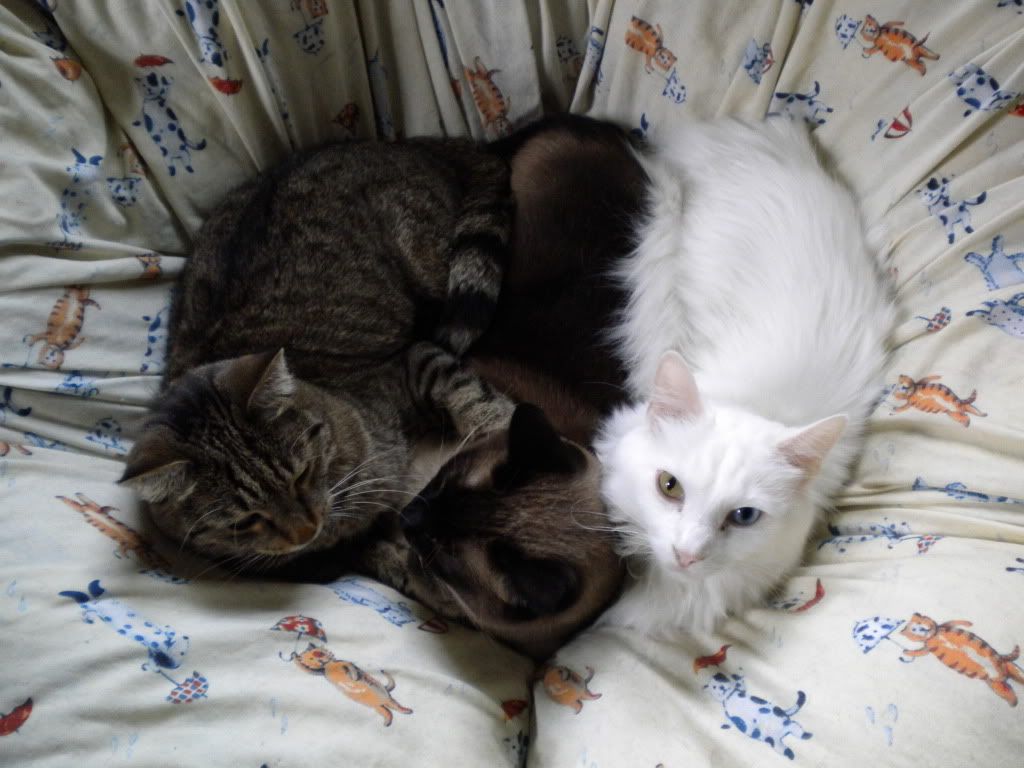
Then someday you'll get to spend your days taking pictures of
adorable cuddle puddles.

PREPARING YOUR HOME
(Best case scenario, you do all this before you get another cat, but these are improvements that can help any cat household no matter how long the cats have been living/fighting together.)

The first thing you need to do is assess your home. If your house isn't multi-cat friendly then you are setting yourself up for failure. To have a smooth introduction and a peaceful life, you first need to check out your litter box situation. The golden rule for litter boxes is: number of cats + 1 and litter boxes should be cleaned daily. Having too few or dirty litter boxes pretty much guarantees cat fights, litter box aversion, or both.

Litter boxes good? Next, your resident cat(s) need a place to mark their territory and your new cat needs some territory to claim as his – for this you need scratching posts and cat trees. (Read about why scratching is important here.) Give your new cat a fresh scratching item, even if it's just one of the lay-on-the-floor cardboard scratchers. Having something of their own to scratch that doesn't smell like the other cats in the home will help you out later on during the actual introduction.

The third thing you should evaluate before bring another cat into your home is vertical space. Like scratching, it's a territory thing. Not having enough vertical space will increase competition in your home and certainly not help your cats get along.

EVALUATE YOUR CURRENT CATS
Are your current cats happy and healthy? Before you bring a new cat home you need to make sure your resident cats are current on their vaccinations and spayed or neutered. Not only do you not want any accidents, but altered cats get along much, much better than they would otherwise. An unaltered male cat would happily kill a new tiny kitten if they were left unattended together in your home.

If you currently have ill or unaltered cats, right now might not be the best time for you to make an addition to your family.
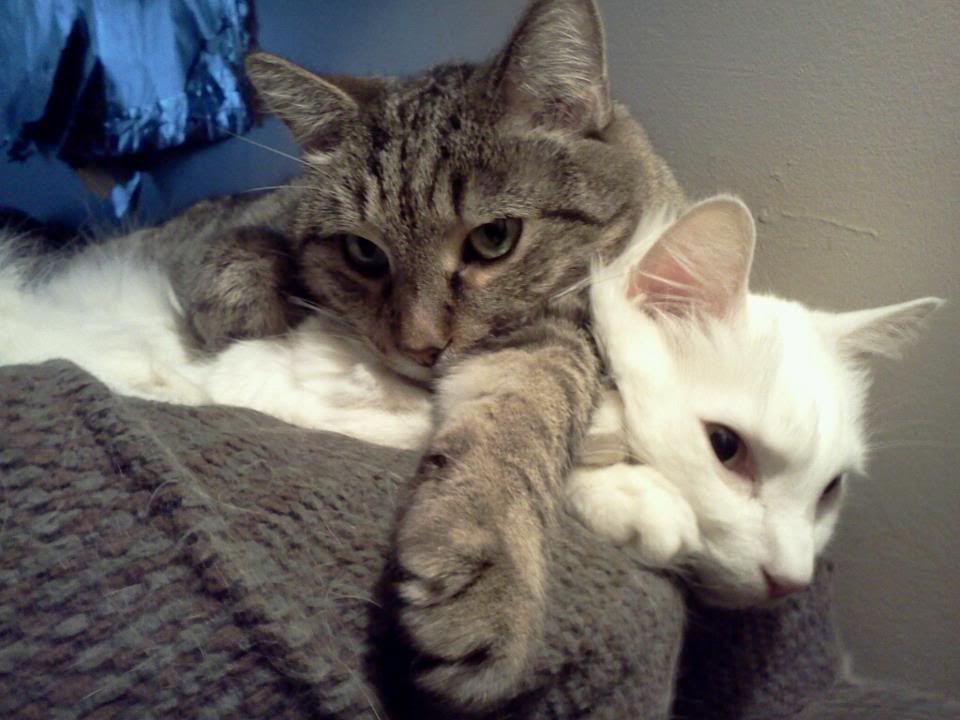

It's hard to believe now that at one time Harry wanted to eat
Damien as a snack.

PREPARING "THE SANCTUARY"
As soon as you walk into your house with a new cat, your current cat(s) are going to know. Even still, your goal is to be as unobtrusive about the new member of your family as possible. Before you bring your new cat home, set up a room just for them.

In this room you need:
  • fresh water
  • food, as needed (dependant on how you're feeding – free or scheduled)
  • a clean litter box
  • something to scratch on
  • something to play with
  • something to sleep on
  • somewhere to hide
When you bring your new cat home, bring them straight to this room. Transport them from wherever you're getting them to this room in a sturdy cat carrier. Try to avoid your other cats, this is a stealth mission. Once in this room, open the carrier door and let your new cat come out. If it's a little kitten, chances are it'll come bounding out and ready to play. A mature cat, however, may take a little time to venture out. Let the cat decide when it is ready to explore it's new home and don't try to force him out!

If you already have a new cat and you're having problems, repeat this step (or do it for the first time). It's the first step to making things better and it keeps your cats safe from each other. Not only are cat fights awful to listen to, but they can cause an array of damage – anything from small bites and scabs, to scratched eyes, to puncture wounds that form abscesses.
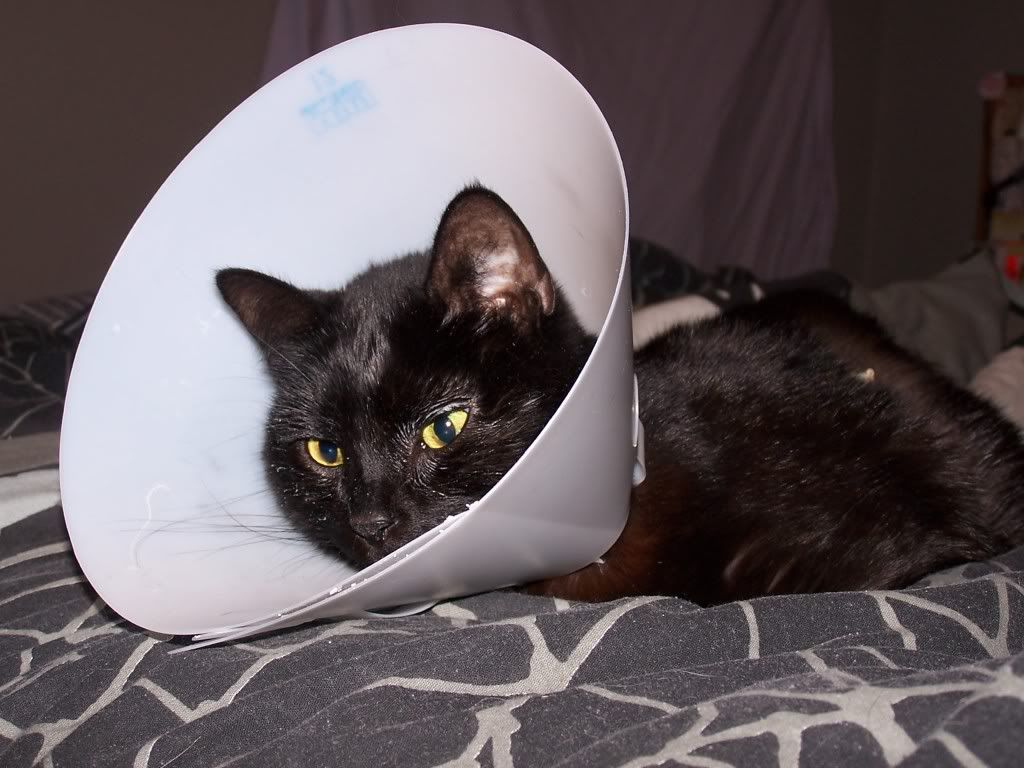
Lola, circa 2004, after getting beat up by another cat while
I was in the shower. She received a puncture wound which
turned into an abscess that had to be drained with a tube.
Nothing about this experience was enjoyable.

NOW WHAT?
You have a new cat! Yay! Keep your new guy in his own private room, and keep your resident cats firmly on the other side of the door. Do not be tempted to do anything more right now. You might think your current cats will be excited for the new addition, and maybe they will be, but rushing the introduction process will only make it take longer to obtain your goal – a peaceful home with cats that like each other.

In Part 2, I will go through the next steps to introducing cats to each other. Until then, just remember that you can't go too slow with this process. Be patient and make sure you show love to all your cats, not just your newbie!


Friday, January 13, 2012

Protect the Hearts of Your Children! Keep the Litter Boxes Clean.


I’m going to start off here with something near and dear to my heart. That is… the litter box.

Me; holding Bootsie, and my little bro; holding Fluffy.

As a little, little girl (we’re talking about three here) I got a cat named Bootsie. When I was five, my parents decided that Bootsie would no longer be a member of our household. Even now, approximately 23 years later, thinking about my goodbye to her brings tears to my eyes.

Imagine me, a tiny girl with big ol’ dimples, hugging her cat while lying in her brother’s race car bed, sobbing and explaining to her that she had to go to the Humane Society because she was a bad cat and begging her to behave better at her new house, assuming she got one.

That day was my first step down the road to Crazy Cat Lady-dom. (Also, it was primer for later adolescent rage at my father, but that’s beside the point.)
 
Why did my parents decide to give Bootsie the boot, you ask? Well, mostly because she peed, daily, on my dad’s work clothes. My dad got sick of smelling like piss, and since she was a “bad cat” for not using the litter box, that was the end of it, on to the next one.  

Cat peeing all over your house? Would you like some help with that? Chances are, the first thing that needs to change is your own behavior.*

Litter Box Etiquette 
(try to think of it from your cat’s point of view)

Minimum, you should be cleaning your litter boxes once daily. If you think the box stinks, your cat most definitely does, seeing as how it can smell better than you. If there’s poop smeared down the sides and they have to dig through stinky, wet litter to do their business (wet litter which, mind you, they then have to lick out of their paws), well, that pile of clothes just gets more inviting.  

          Make it part of your routine. I clean mine right before I feed my crew their evening meal. Even with eight cats, done daily, it takes less than five minutes. When I had my crazy retail schedule, I cleaned them right before bed.

Another added benefit of daily cleanings is that you look at their waste everyday. I know that doesn't seem like a benefit, but it means you will notice any changes or abnormalities right away.
           
First, start with a clean, dry, empty litter box. Then get some clumping cat litter. Fill the box deep enough that pee and poo piles won’t touch the bottom. Next, scoop daily. If a clump is stuck to the side or bottom, pick up the box and tap it forcefully against the ground to dislodge it without breaking it with your scoop. Keep clumping litter on hand to top off the litter when it gets too low. Keep your scoop and the sides of the box clean. The chore of cleaning boxes gets way less nasty and time consuming like this. I promise. Keep in mind that filthy litter boxes are more likely to spread toxoplasmosis (http://www.ncbi.nlm.nih.gov/pubmedhealth/PMH0001661/) and nobody wants that!

Keep food and water away from the litter boxes, in another room preferably. Nobody likes eating food while their nostrils are filled with the scent of their own waste.

Make sure your cat feels safe while using the litter box. Something as simple as your washing machine being loud or another cat harassing them can send them running to their favorite not-deemed-appropriate-by-people potty spot. Situate your litter boxes so nothing (your other cat, your dog, your child, whatever it may be) makes kitty feel cornered. Always give them an out. 

Golden Rule for multi-cat households; have as many litter boxes as you do cats, plus one. (Example: 3 cats, 4 litter boxes) Spread your litter boxes out in your household, otherwise you may be putting every box you have in one cat’s territory.

The goal is to make the litter box a lovely and inviting place for your cat. You may like that covered litter box because it keeps the smell in, but that’s exactly why your cat hates it. Keep things simple, clean, and unscented. Finally, remember that if you give your cat an option that it views as better, it will go there, so buy a hamper with a lid and pick up the stuff on the floor!

*Health issues, such as UTI’s, can cause litter box aversion problems, make sure your cats have a clean bill of health.