Showing posts with label cat tree. Show all posts

Wednesday, March 14, 2012

You Brought Home Another One? (Part 1)

As anyone who has tried knows, introducing cats can be a difficult thing. The secret is making the introduction as slowly as possible and keeping the interactions between your cats positive. There is no timeline that works for every cat, it depends on their individual personalities and on if your home is set up adequately to house multiple cats. If you've already introduced your cats and it didn't go very well, it's not too late to repair the damage. In this post I'm going to lay out an "ideal" way to introduce cats to each other, as well as give some backtracking tips if your cats are already having problems.

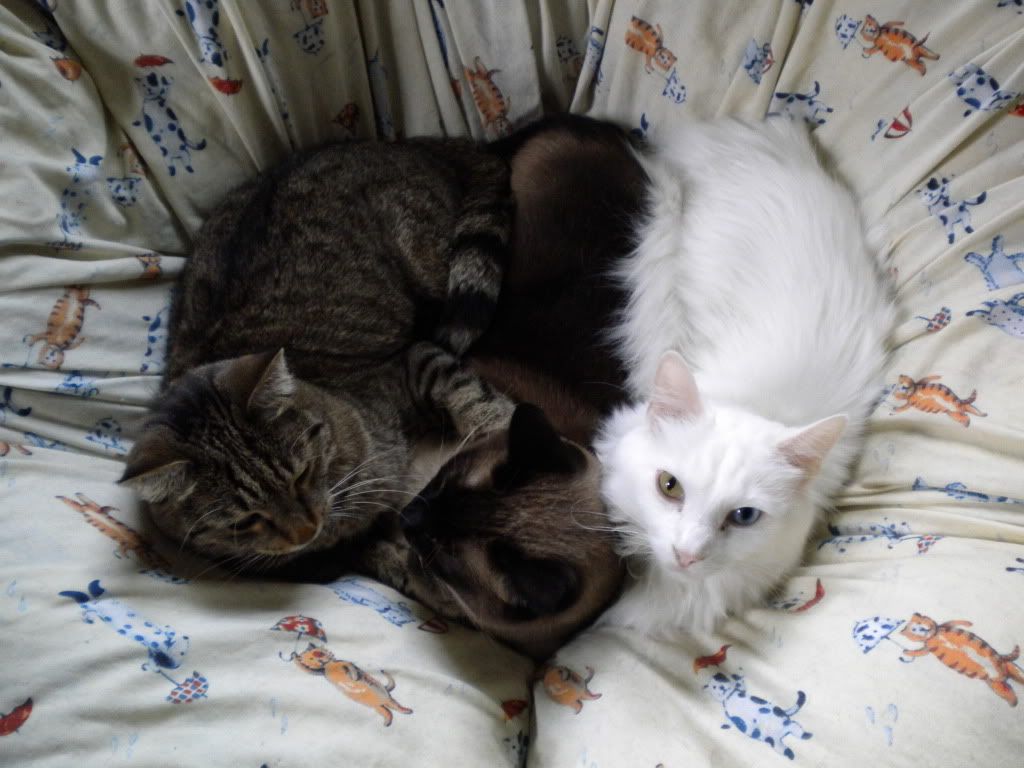
Then someday you'll get to spend your days taking pictures of
adorable cuddle puddles.

PREPARING YOUR HOME
(Best case scenario, you do all this before you get another cat, but these are improvements that can help any cat household no matter how long the cats have been living/fighting together.)

The first thing you need to do is assess your home. If your house isn't multi-cat friendly then you are setting yourself up for failure. To have a smooth introduction and a peaceful life, you first need to check out your litter box situation. The golden rule for litter boxes is: number of cats + 1 and litter boxes should be cleaned daily. Having too few or dirty litter boxes pretty much guarantees cat fights, litter box aversion, or both.

Litter boxes good? Next, your resident cat(s) need a place to mark their territory and your new cat needs some territory to claim as his – for this you need scratching posts and cat trees. (Read about why scratching is important here.) Give your new cat a fresh scratching item, even if it's just one of the lay-on-the-floor cardboard scratchers. Having something of their own to scratch that doesn't smell like the other cats in the home will help you out later on during the actual introduction.

The third thing you should evaluate before bring another cat into your home is vertical space. Like scratching, it's a territory thing. Not having enough vertical space will increase competition in your home and certainly not help your cats get along.

EVALUATE YOUR CURRENT CATS
Are your current cats happy and healthy? Before you bring a new cat home you need to make sure your resident cats are current on their vaccinations and spayed or neutered. Not only do you not want any accidents, but altered cats get along much, much better than they would otherwise. An unaltered male cat would happily kill a new tiny kitten if they were left unattended together in your home.

If you currently have ill or unaltered cats, right now might not be the best time for you to make an addition to your family.
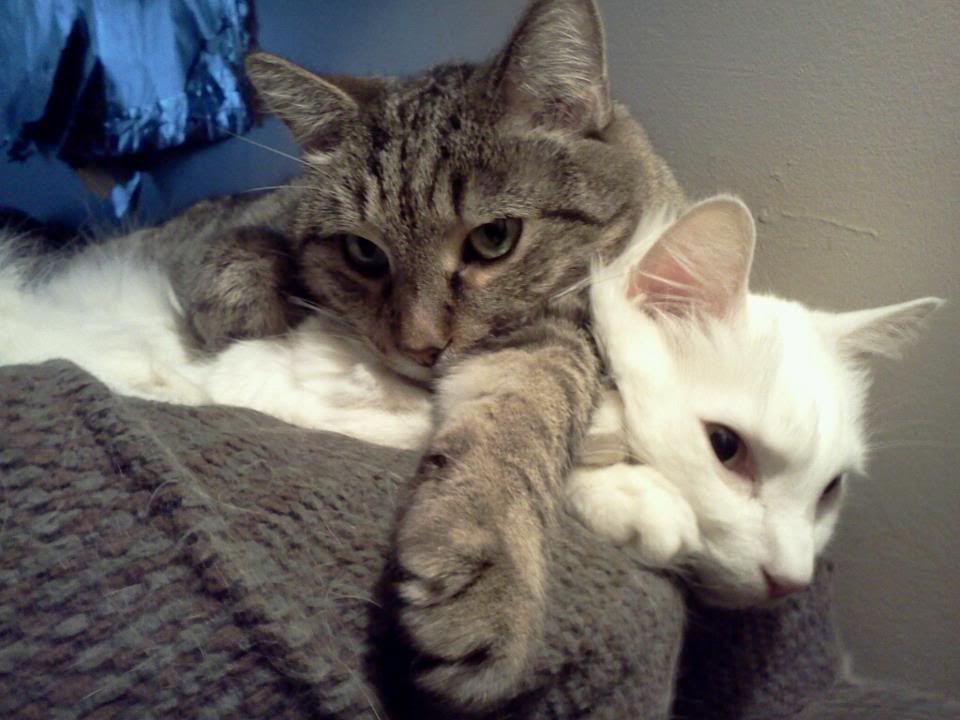

It's hard to believe now that at one time Harry wanted to eat
Damien as a snack.

PREPARING "THE SANCTUARY"
As soon as you walk into your house with a new cat, your current cat(s) are going to know. Even still, your goal is to be as unobtrusive about the new member of your family as possible. Before you bring your new cat home, set up a room just for them.

In this room you need:
  • fresh water
  • food, as needed (dependant on how you're feeding – free or scheduled)
  • a clean litter box
  • something to scratch on
  • something to play with
  • something to sleep on
  • somewhere to hide
When you bring your new cat home, bring them straight to this room. Transport them from wherever you're getting them to this room in a sturdy cat carrier. Try to avoid your other cats, this is a stealth mission. Once in this room, open the carrier door and let your new cat come out. If it's a little kitten, chances are it'll come bounding out and ready to play. A mature cat, however, may take a little time to venture out. Let the cat decide when it is ready to explore it's new home and don't try to force him out!

If you already have a new cat and you're having problems, repeat this step (or do it for the first time). It's the first step to making things better and it keeps your cats safe from each other. Not only are cat fights awful to listen to, but they can cause an array of damage – anything from small bites and scabs, to scratched eyes, to puncture wounds that form abscesses.
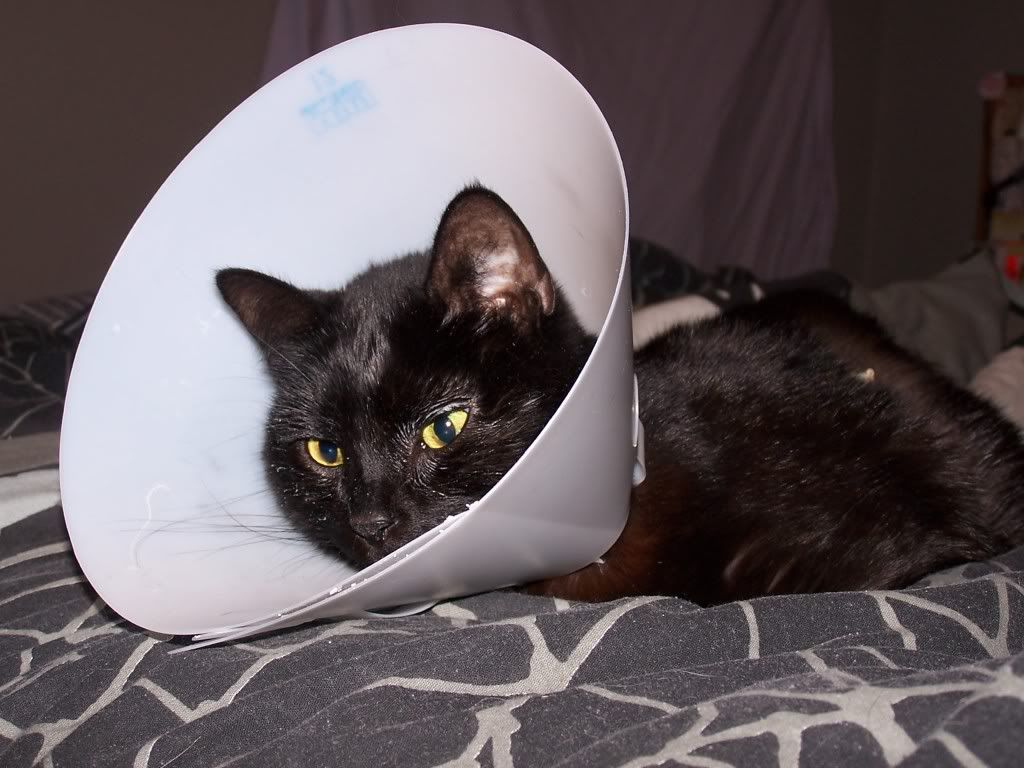
Lola, circa 2004, after getting beat up by another cat while
I was in the shower. She received a puncture wound which
turned into an abscess that had to be drained with a tube.
Nothing about this experience was enjoyable.

NOW WHAT?
You have a new cat! Yay! Keep your new guy in his own private room, and keep your resident cats firmly on the other side of the door. Do not be tempted to do anything more right now. You might think your current cats will be excited for the new addition, and maybe they will be, but rushing the introduction process will only make it take longer to obtain your goal – a peaceful home with cats that like each other.

In Part 2, I will go through the next steps to introducing cats to each other. Until then, just remember that you can't go too slow with this process. Be patient and make sure you show love to all your cats, not just your newbie!


Tuesday, February 7, 2012

Changing Scratching Habits

Cats scratch - nothing you do will ever change that. It's natural, normal, and just part of having (or being) a cat. Understanding why your cat scratches and accepting that it's an unchangeable behavior enables you to have more control over where your cat chooses to scratch.

WHY CATS SCRATCH
Thankfully a house cat causes less
damage than this guy! Photo via
http://www.nationalgeographicstock.com/
Territory is really important to all felines, including your house cat. Scratching, no matter if it's a tree trunk, fence post, or your couch, leaves a visible sign of marked territory. Not only is a scratched item an instantly visible sign that something has been claimed, but the scent glands present in your cat's paws creates an aromatic message board as well. You may not be able to smell the "eau de cat" left behind, but to another cat it's a veritable gold mine of information. Scratching as a form of marking territory is a base behavior in cats and not one you can expect to change.

In addition to marking territory, scratching helps keep nails sharp and healthy by aiding in the removal of old nail sheaths. The old, dead sheaths are shed while your cat is scratching or they are removed by your cat chewing them off. After an old sheath is removed your kitty is left with a super sharp and fresh nail underneath.

Finally, can you imagine how good it must feel to dig your claws in and really stretch out your 30 flexible spinal vertebrae? Probably amazing.

ENCOURAGE APPROPRIATE SCRATCHING
Cats are going to scratch no matter what, but that doesn't mean that all your possessions are doomed to be shredded. Step one in protecting your stuff from claws is giving your cat plenty of other things that are perfectly acceptable to scratch. Step two is making sure these "things to scratch" are things your cat will actually view as desirable.

So what's your cat looking for? It needs to be sturdy, tall enough your cat can get a full stretch, and covered with a material that's pleasant to scratch on (sisal and carpet are popular in my house). You have many options here. If you live in a multi-cat household, consider a cat tree. I have one that was hand built for me about 10 years ago and one that was purchased in a pet store about 8 years ago. They are both still in decent shape, but the hand built one has proved to be the higher quality of the two. I also have a cat approved sisal-wrapped scratching post that hangs from a door knob, it's only downside being that it bangs on the door while in use (that's why it lives on the hall closet door, as opposed to say, the bedroom door.) Another type my cats tend to enjoy are the corrugated cardboard ones that lay flat on the ground, their major downside being that as they get torn up they get messy.


basic cat tree
 via http://www.catsplay.com/best_cliffside.php3
Shop around, you can find some deals, or
if you're crafty, build your own!

The corrugated cardboard "Super
Scratcher". You can find these
at nearly any pet store.


Another thing to consider while creating places for appropriate scratching is that some cats prefer vertical scratching and some horizontal. If your cat is a fan of horizontal scratching, try to find an elevated spot to put a horizontal scratching post. If your only horizontal post option is on the floor, kitty may still find the top of the back of your couch or chair preferable.

The placement of your scratching posts is very important. If you buy a couple posts, then throw them in the dark, damp, lonely basement, your cat isn't going to look twice at them. Remember that scratching is marking territory—meaning that cat trees and scratching posts need to be placed in prominent positions. Place them strategically around your home in areas where you and your family spend ample time and where your cat has already shown it likes to scratch. If you get a cat tree, put it by some windows!

IF YOUR CAT ALREADY HAS BAD HABITS
Training a cat is a good mix of of creating positive associations with what you want the cat to do, while making what you don't want the cat to do as unappealing as possible. So, if your cat is already scratching the crap out of everything, the first step towards resolving the issue is placing scratching posts and cat trees in multiple cat-friendly locations around your home.

Step two is to make what your cat is currently scratching a less-desirable choice then the cat trees and/or scratching posts that are offered. I'm going to be honest here, the suggestions I'm offering are things I've read or heard about and not actually tried. As our house is an active place, I long ago accepted that our furniture would see some rough love. If a cat is caught scratching inappropriately they are stopped, but that's about as far as it goes. Plus, you never know how you're going to feel down the line, I was bummed when Belle clawed a hole in my Deftones shirt, but now when I wear it I look at that hole very fondly. All that aside, I do believe that it is possible to prevent the vast majority of damage caused by cat claws if you put in some effort.

So, to make a scratching spot less-desirable, here are some ideas for you to try:
  • Cover said item in aluminum foil, cats are supposed to dislike the feeling of it on their paws.
  • Cover said item with double sided tape, cats are also supposed to dislike the sticky feeling.
  • Cover said item in some other way, a blanket, a tarp, anything that would make scratching less enjoyable. The "cover it" route isn't a solution, but a temporary diversion to encourage your cat to scratch on the proper items you have provided.
  • If kitty's caught in the act, startle them with a loud, firm "no", a spray from a bottle of water, or just simply remove them from the area.
And here are some things to avoid:
  • Don't physically punish your cat.
  • Don't attempt to discipline your cat for scratching after the fact. Catching your cat in the act is the only opportunity you have to correct it's behavior.
  • If your cat isn't showing interest in a scratching post don't try to "teach" them to use it. Forcing them to scratch it will just create a negative association. A much better way to draw your cat's interest would be to rub it over with some catnip.

CLAWS
Keeping claws trim will help to reduce damage to your furniture, as well as to anyone your cat may accidentally scratch. (Read about how to trim nails here.) Another option, untested by me, is cat nail covers. A former coworker of mine raved about these (SoftClaws in particular) and they also seem to get positive reviews on the internet, but again, I have never tried them. Update: One of our new bike polo players uses them. He says they are easy, cheap, and effective. Plus, you can make your cats nails be whatever color you'd like.

ON DECLAWING
Just don't do it, it's so disgusting. Onychectomy (or "declawing") is hardly practiced outside of North America and is prohibited and/or strongly looked down upon in Australia, Brazil, Austria, and the United Kingdom. In Israel, Finland, Estonia, the Netherlands, Germany, and Switzerland you can be charged with animal cruelty for declawing your cat. Love your cat enough to not put it through an incredible amount of pain and permanent disfigurement.